
What is commonly known as Italian Bread in the states is something like French Bread but typically softer. The dough typically contains some olive oil and dairy to soften things up, and instead of steaming the oven to maximize crust you brush the crust with water before placing it in the oven which keeps it softer and chewier. It is the perfect spongy bread for mopping up pasta sauces, and quite good on its own.
This is based on the recipe from Bernard Clayton's New Complete Book of Breads. I used a preferment: he does not. I'm not sure if it made a difference or not, but the way I made it turned out quite good.
Italian Bread
To start the preferment, mix together the flour, water, and yeast in a small bowl and cover with plastic wrap. Leave out at room temperature for at least 4 hours and as long as 16 hours.
To make the dough, mix together the preferment, water, olive oil, yeast, salt, malt powder, and dry milk in a bowl with 2 more cups of flour. Mix thoroughly. Mix or knead in the rest of the flour a half a cup as a time until you have a slack dough but one that is no longer sticky. Total mixing time should be in the ballpark of 10 to 15 minutes.
Place the dough in a well-greased bowl and cover with plastic wrap. Allow to rise at room temperature until at least 2 times in size, approximately 2 hours. Punch the dough down and let it rise again for half an hour.
Remove the dough from the bowl and divide it in half. Shape the dough into a ball or log, cover with a damp towel, and allow it to relax for another 20 minutes.
Shape the dough into its final shape. Cover again and allow to rise for another hour until doubled in bulk.
Meanwhile, preheat the oven and baking stone, if you are using one, to 425 degrees.
Right before placing the loaves in the oven brush or spray them lightly with water. Place them into the oven and bake for 20 minutes before rotating them. Bake them another 20 to 30 minutes or until the internal temperature of the loaf reads 200 degrees. Remove from the oven and allow to cool for at least a half an hour before serving.
Related Recipe: Rustic Bread
This is based on the recipe from Bernard Clayton's New Complete Book of Breads. I used a preferment: he does not. I'm not sure if it made a difference or not, but the way I made it turned out quite good.
Italian Bread
Makes 2 large 2 pound loaves
Preferment:
1 cup water
1 cup bread or all-purpose unbleached flour
1/2 teaspoon instant yeast
Dough:
All of the preferment
5 cups bread or all-purpose unbleached flour
1/2 cup nonfat dry milk
1 tablespoon malt syrup, malt powder, brown sugar, or sugar
1 tablespoon salt
2 teaspoons instant yeast
1 tablespoon olive oil
2 cups water
To start the preferment, mix together the flour, water, and yeast in a small bowl and cover with plastic wrap. Leave out at room temperature for at least 4 hours and as long as 16 hours.
To make the dough, mix together the preferment, water, olive oil, yeast, salt, malt powder, and dry milk in a bowl with 2 more cups of flour. Mix thoroughly. Mix or knead in the rest of the flour a half a cup as a time until you have a slack dough but one that is no longer sticky. Total mixing time should be in the ballpark of 10 to 15 minutes.
Place the dough in a well-greased bowl and cover with plastic wrap. Allow to rise at room temperature until at least 2 times in size, approximately 2 hours. Punch the dough down and let it rise again for half an hour.
Remove the dough from the bowl and divide it in half. Shape the dough into a ball or log, cover with a damp towel, and allow it to relax for another 20 minutes.
Shape the dough into its final shape. Cover again and allow to rise for another hour until doubled in bulk.
Meanwhile, preheat the oven and baking stone, if you are using one, to 425 degrees.
Right before placing the loaves in the oven brush or spray them lightly with water. Place them into the oven and bake for 20 minutes before rotating them. Bake them another 20 to 30 minutes or until the internal temperature of the loaf reads 200 degrees. Remove from the oven and allow to cool for at least a half an hour before serving.
Related Recipe: Rustic Bread
Comments
I routinely bake more than one loaf at a time and freeze those that won't be eaten right away. The mess for one loaf or four is about the same and so is the energy usage with the oven. For short-term storage in the freezer (a couple of weeks), a single bag works just fine. For longer storage, upwards of a couple of months, you'll probably be better off double-bagging the bread. In either situation, the key is to remove as much of the air from the bag as as you can while closing it, as this helps slow the loss of moisture from the bread. I tend to shy away from zip-loc style bags. The plastic is stiffer, which makes it harder to expel the extra air, and the shape usually won't accomodate a loaf of bread. When I find them in the store, I buy 1-gallon size bags with twist-tie closures. Some of the packages even recommend them for freezing bread, because the bag conforms to the shape of the loaf. If there is a bakery outlet or supply store in your area, you may be able to purchase new bags that the commercial bakers use. They work pretty well for short-tem freezer use, too.
PMcCool
i also always make extra loaves to freeze... I use the Saran style wrap from Costco, it allows you to tightly wrap the loaf with no air. I then place in a freezer bag, which can be reused
The Rustic bread recipe that you posted worked great for me. I froze one loaf so I can enjoy it later. I am going to try the Italian Bread this weekend.
george.....Still Trying to find a good loaf of bread in South Florida!
I made this bread yesterday. It didn't rise as high as I would have liked but the crumb and taste are great! Floyd's "snail" recipe is rising as I type this. Pictures of that later...
Here's the Italian:
I'm going to try to convert this recipe to a whole wheat, no-knead recipe. Are you adding the powdered milk to make up for using processed flour? If I want to eliminate the powdered milk can I substitute some whole milk for the water? If so, how much? I'm chomping at the bit to try this...
Cliff. Johnston
"May the best you've ever seen,
Be the worst you'll ever see;"
from A Scots Toast by Allan Ramsay
I don't have any powered milk today. What can I substitute?
Steph
I have always subbed skim milk (that's all I drink) in place of the dry. So I would use 1/2 cup of milk and 1 1/2 cups of water. I wouldn't think the fat content of whole milk would make much difference. I find no discernable difference, it is such a small amount.
A more precise substitution for the 1/2 cup powdered dry milk and 1-1/2 cups water would be 1-1/2 cups milk and 1/2 cup water. I imagine either way will give you good bread, but there are some areas where the milk/water difference would make quite a difference.
To get 1 cup of milk, place 1/3 cup of powdered milk in a 1 cup measure and fill the cup with water. These figures are for instant powdered milk, they may be different for the non-instant kind.
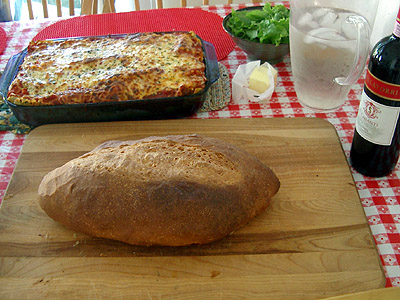
Mentioned that scrumptuous looking Lasagna or baked item that's BEHIND the bread?? I think we need THAT recipe as well.
Oh, and thanks for making the distinction between Italian and French breads.
I'm also a fan of Clayton's. He's from my home state, so I'm rather biased, though.
You must scald milk before using if you are using skim or whole milk instead of dry milk - otherwise bread may not rise.
It must be that Bernard Clayton was born before the development of scales to weigh ingredients. Clayton has a lot of good recipes but you have to pick a weight for a cup of flour and substitute the weight for the volume measurement. i use 5 oz but there has been much debate on this site about the exact weight to substitute.
The point is that you used a cup that did not put enough flour into the mixture. My volume cups are usually 20-25% too light compared to my standard of 5 oz. That's probably why your dough was slack. Makes great taste and crust but can't hold its shape.
Paul Kobulnicky
Baking in Ohio
Pizza doughs are all over the map in terms of high-gluten vs. low-gluten flour, olive oil vs. no olive oil, milk product vs. no milk product, etc. In my experience they all work; they just produce somewhat different crusts.
Floyd's Italian bread recipe looks very similar to my base pizza dough recipe except that I use yoghurt or buttermilk rather than dried milk. You will want to cook it at a lower temperature than a straight dough - around 425-435 deg.F. The crust will be brown on the bottom and have a somewhat more breadlike structure than a New York-style straight dough.
sPh
Tonight I made pizza with the second 1/2 of Floyd's Italian Bread dough (I used the first half for my B's Hidden Focassia)...The pizza was awesome...thanks for your help!
Beth
malt both dry and syrup are interchainable
malt is directly digestable by yeast and is used as a yeast food for a faster rise and will provide a mild malt tast to the bread but since the yeast will eat it up very quickly it is mostly gone by the time you bake the bread
sucrose or table sugas is not directly digested and must be broken down into sympler compounds before the yeast can use it for food the result is more ETOH in the bread (Alcohol) and a slower rise.
since the yeast has a harder time using sucrose more is left in the dough at baking time your bread will be sweeter and will get a faster and darker crust as the left over sugar close to the surface carmalizis.
brown sugar in the same as sucrose execpt a percentage of molases have been left in during the refining process this also must be broken down before yeast can use it as food the results will be simaler to sucrose with the diferance of color and the taste that the molasses will provide
Baker Ret.
put your dough in the bowl and cover with either a damp cloth or plastic wrap, they will give the same results. It keeps the air movement out of the bowl and lets the dough rise without drying out the surface and forming a crust on the dough, thus inhibiting the rise. DO NOT WRAP YOUR DOUGH IN A DAMP TOWEL!!!!!!!! If you do, you will have a mess, as the dough will stick to the cloth and will defeat the purpose of the proofing by deflating your dough when you try to remove the towel. Also, before you cover the dough for the proofing be sure that you either spray some non-stick spray, or oil on the dough so once it gets to full volume it does not stick to the covering, if by chance it touches the covering.
After you shape your dough you need to again cover but not necessarily with a damp cloth, plastic wrap works great, just be sure you lightly spray the plastic wrap or the top of your bread so you don't have the cover sticking.
Bake your bread on a cookie sheet in the middle of the oven.
For the dry or liquid malt, the best place to buy it is at a home brew store, where they sell products for the person who makes beer at home.
Cheesecake man (Rick)
Hi everyone,
I have a question about this malt powder, I got the diastatic malt powder from the King Arthur site, actually I bought 2 bags, then someone mentioned malted milk powder from the store, so I got that too but I am confused on which to use, when you guys mention malt powder in these recipes, which are you talking about? So far my bread making has been bad, I also have the vital wheat gluten and just got some wheat bran, dry milk too, potato flakes, now I just need some serious advice, on what not to use here. TIA
little_limey: it all depends on what shape you want for your final product. If you want it to be a free form loaf you can use any of the three items you mentioned. If you use the baking stone you can either final proof on parchment paper and transfer to the hot stone or use a pizza peel, with corn meal on the peel, for final proof and slide the bread off of the peel onto the stone. There are a number of other ways you can proof your bread and transfer to the stone, just need to experiment and see what works for you. As for using a casserole dish, if it is large enough you can probably free form, proof and bake. You will find the crust on the bread from using the baking stone will be a little more crunchy. I practiced with the cookie sheet before I finally purchased my stone.
Paddyscake: I have found by double bagging the powdered malt it will stay for a long time without getting hard. But, one of the secrets I have found is dip into the bag real quick to pull out the amount I need and then close very quickly (squeeze the air out). This whole process should take just a few seconds - the quicker the better!!!!!!!! Also, when you put the malt into your flour be sure to incorporate it immediately (which you probably already know) or you will find it will begin to collect moisture and get lumpy and hard in a matter of seconds. Sounds like it is not worth the effort but as you know from using malt it does add to the flavor of the bread and bagels.
Like sheikyurbouti said: "malted barley loves moisture" So, to reiterate, you need to have the bag open as little as possible - that is also true with the Carnation malt that you buy in the jar at the grocery store.
Hope this helps.
Cheesecake man (Rick)
This is my first try at the Italian loaf. I have taken quite a few baking classes and seem to pick up recipes rather easily. I'm very happy with the results as this is my first time using a preferment. I am so inspired to continue to challnge myself with new methods and recipes thanks to this website!!
I have my pictures of my loaf in the link listed below.. Can't seem to figure out how to upload onto this site...
Many Thanks!
http://www.flickr.com/photos/asherdesigns/2743109963/
I cut the recipe in half and started the preferment for this before I went to work yesterday and finished it after I got home. It was the first loaf of yeast bread I've made, and despite a few little problems, I couldn't be more excited. I wanted a loaf that would have a nice soft crust, as that's what my boyfriend prefers, to turn into garlic bread to keep on hand in the freezer for nights when we have pasta, and this sounded perfect. Unfortunately, I couldn't keep my boyfriend from playing with the dial on the oven, and this is only the second time we've used it (we just moved in) and it is numbered 1-8 instead of giving degrees... So there was quite a bit of guessing and hoping, and I forgot to spray the bread with water before sticking it in. It came out with quite a crunchy crust.
I couldn't keep my boyfriend away from it for 5 minutes, let alone the 30 the recipe called for, and we were pleased to find it still turned out well, despite being crunchier than I'd hoped. And this morning, I found that what is left of the loaf has the much softer, chewier crust that I was looking for. I don't think any of it is going to make it to the freezer though, so I'll be baking more soon. I'll probably make the full two loaves, just to ensure atleast some of it becomes garlic bread.
Hi,
My family like Itaian bread that are flour water, salt, yeast, and someplaces add an oil, and as a kid, it was lard or commercial crisco type fat, not much , but some. The Pizzerias I did electrical work in , did not use eggs or milk in their doughs, nor the one I almost bought used it either. I also did work in "bread Bakeries" they also di not use milk or milk producs in breads. I watched closely actually , and asked. Since I was an "electrician" they tought me either stupid or inept, and never really paid much attention except to answer questions.
The ecpetions are there to be sure, there are pizzerias that add everyhting to the dough, but the classics do not, and what I call Italian Breads you would say is French bread. No eggs , No dairy. My dad cannot tell you what the diff is, but he will tell you he doesn't like it. He does eat breads with dairy and eggs, but when we say Itailan bread, they are 1 of two kinds, (usually)big rounds (ciabatta?, panetone?eh, I no Capicse) with nice holes, or "regular" which is a baguette style. And dad will TRAVEl to get a better bread.
Then they also make "lard bread" which has tons of pig fat and chopped proscuitto, and cracked black pepper corns. I make a varient with bits of provolone. This is regulated by orders from Cardiologist. You can also make it with sausage, , just brown up porks sausage (with seeds please), use sweet or hot, gring it up add it to the flour with ALLL the drippings, and add more fat as kneaded. I can't give recipe w/o clearence from you cardiologist, and lawyers, and you must have will made out.
sparkie
As a follow-up to my previous dilemma.. Once it has risen the first time, can I incorporate more flour prior to the 2nd or 3rd rise or will that good it up? It was pretty dry in my house and I didn't weigh the flour. there were no weights listed in the recipe. I thought - if anything - I'd need less flour but apparently my thinking was somewhat flawed. I"d really like to be able to work with this dough, but it's way to soft to shape.
Not your fault you didn't use weights since it states volume only and talks about "punching down" the dough. An old recipe, for certain.
Adding more flour after the bulk fermentation would result in lines of unincorporated flour throughout the crumb after it is baked.
When the dough is ready to shape, placing it on a heavily floured surface will make it a bit easier to work with. If you have a banneton or couche, you could try using either. Or you could just treat it as a ciabatta, cut the dough in half, and move it to parchment for baking on your stone.
It may not wind up pretty, but am betting it will still taste good.
Here are the two loaves that I made. The smaller one I did actually knead in some additional flour in the middle of the 2nd rise. I baked it in a preheated enamel coated cast iron dutch oven. I generously brushed it with water before putting it in the oven. The texture was much smoother.
The larger one was without additional flour, but allowed to rise on a floured towel. apparently not quite long enough. I also baked this one in a preheated dutch oven - lid on for the first 30 minutes and 20 minutes with the lid off. There were quite a few holes in this one. More like ciabatta, only round.
Both tasted great!
Next time I'll knead in enough flour to start with. Then hopefully I can shape them into a nice size loaf. If I were to make one large loaf - how long would I bake them?
I wouldn't go too wild with adding more flour. Looks like a nice shape. I especially like the floured one. Doubled might take from 60 to 75 minutes ... use a thermometer to check inside for doneness.
Crumb shot! Crumb shot! Crumb shot!
I think the only reason I mainted the shape was because I did bake both of them in enameled cast iron dutch ovens. The large was one literally Poured into the pan from the floured towel - hence all the flour on it. The smaller one had a little bit of a shape to it.
Here are the photos. The color is a little funky. Not sure why. the photos seem to run together. I guess I don't know how to upload properly.

It took some looking, you were hiding in the old dates! That's why we easily missed you... ok you wrote:
If the shaping is really awkward, then I suggest you add a bit more flour when mixing up the dough. Reads like you figured out about rolling dough around on floured towels. Parchment works if you don't plan on turning or flipping the dough over because unbaked dough can really stick to it, it releases after it's baked. I've lowered risen loaves into pots on parchment. I've also put dough into floured cold dutch ovens and let them proof inside, slashed when ready (to avoid super sized bubbles on top) and baked with the lid on in a hot oven. Add about 5-10 minutes to the baking time and remove lids at your own discretion.
Thanks for the crumb shots! The bread looks good! I wouldn't say they were underproofed at all. I think you could easily combine both loaves into one.
About the upload... not to worry. What you have to do is move your curser to the end of the picture and start a new paragraph before downloading the next picture. Ahhh you'll get the hang of it in no time...
Mini O
I really appreciate the input. I had thought about allowing the dough to rise on parchment in one dutch oven and then preheat another. Move it - parchment and all to the preheated one when ready - that way it would kind of maintain it's shape. I thought I read somewhere that breads cooked on parchment need to have the paper removed shortly after putting in the oven, but I guess that's not true? I know I've used parchment on other breads and not had a problem.
I have a friend who owns a donut shop and she gets me my parchment from her supplier. 1,000 large sheets (commercial pan size) for under $40. I share it with my daughter - DIL and my daughter's MIL. I won't live long enough to use it all )-: since I also ordered 1K of the 8" rounds. Parchment is wonderful stuff.
My son also is into bread baking. I just sent him a link to this site. Expect to see some of his stuff soon. He has done a lot more experimenting than I. We have a good time when we get together every month or so.
Thanks for all the input and information. This has to be my favorite site!
PS: My hubby loves the bread! I made homemade Italian Beef and he's been devouring both over the last couple of days.
These were my fifth try at bread baking, and my first free form loaves on a stone, and at several points I was sure I'd made a total botch up of it. I made the preferment with the last of my Pillsbury Bread flour and the rest with Gold Medal Better for Bread(which seemed really coarse). The dough was very sticky and hard to manage, despite adding a good deal of flour in kneading, and they stuck like mad to the bread board during shaping. Also, I didn't think about how to get them from the boad to the stone until nearly time to bake, and I didn't have a peel or parchment, so I winged it.
The loaves attatched a little where they touched, but they held their shape and rose well, and taste terrific. Thanks for the recipe!
Floyd, or anyone who can answer this... Life interfered today and I wasn't able to bake the loaf today. Now my preferment is way past the 16 hour mark and I won't be able to use it until tomorrow. I know I can refeed it, but I don't know the rules. Do I do it now, or tomorrow? How much do I remove, how much do I add back in, and when do I do it?
No biggie. Start over. Seriously.
Next time, if possible, refrigerate within the given time range, if not using.
Far from an expert myself but I've seen this question asked several times at the King Arthur Flour blogs. I reckon it's because it will probably take about as much time and expense to refresh as it would to just reconstruct.
Floyd do you weigh your flour? Have you ever?
Do you know the typical weight of a cup ap flour as you measure it? Do you think it closer to the 4.25 oz usda/KA specification, or the 5 oz per cup Cook's Illustrated method of measuring?
Thanks.
I made this today.,.. made the preferment last night and started mixing it all up early this morning. I am VERY pleased with it !! I was worried it was getting too dark before the time was up, and it got a bit too dark in a couple spots on the bottom. I used cookie sheets though.,.. guess I need to be getting a stone , since I've really gotten excited about baking bread. Since I found this forum, I have started experimenting with the various recipes,,..... I'm very glad I found this forum, and thanks to everyone, for ALL the valuable input !
The pre-bake loaves were kind of flat which worried me but I set them into a 425 oven (I think mine runs hot ...) for 1 minute, then turned it to 400 for about 35-ish minutes. They popped up real nice. I don't want to cut this loaf right now b/c I'm bringing it to my sister's house tonight for dinner.
this will be garlic bread before the sun has set ...
Hello everyone :) I'm brand new. This is a great site and I'm learning a lot.
I just made this bread today and it's very good. My boyfriend has single handedly eaten half the loaf in a sitting. LOL
I did have the issue where the dough was extremely wet and ended up adding an additional 200g of flour. Even after kneading it for quite a while, it was still very sticky and slack...but I didn't want to add anymore flour so I just crossed my fingers and let it rise.
It turned out rather well for my third loaf (I started baking for the first time last Friday). The only thing I noticed was that my crumb is pretty dense (similar to sandwich bread) and I wondered if that was from over kneading the dough? The bread as a whole was nice and soft with a chewy crust...so that was very good.
I would love to post pictures, but my camera needs batteries. :(
hi, I've just made a batch of dough for this italian bread, I used the french fold method, and its having its first proof now.
I just wanted to ask, was it supposed to be a wet dough? coz mine wasn't (nothing like the 'my daily bread'),
also, it didn't take too long with the french fold method to come together. not sure if I'm on the right track?
also, there was slight tearing of the dough as I worked it, does this mean the dough is too dry?
According to the recipe, the dough will be "slack", but not sticky.
If you read through the thread, some(many?) had quite wet doughs, but again, according to the recipe, keep adding flour(a little at a time), until it is no longer sticky.
thank you for replying. yes, thats what got me confused, as so many experienced a really wet, hard-to-handle dough, but I didn't experience this.
I just remembered that when I added the flour, I forgot and added it all at once, could this be why, do you suppose? thanks
That's the most likely explanation. Those must have been some pretty heavily loaded cups of flour. A cup of fluffed flour should only weigh about 4.5 oz or so.
As long as the dough was relatively soft, it'll likely be ok.
Hi, love love love this bread! will definately be making over and over again.
took some pics with phone, have a crumb shot too! how do I upload? thanks :)
Posting photos FAQ:
http://www.thefreshloaf.com/node/2960/posting-photos-faq
These steps from poster Debra Wink have also been said to be very helpful:"
1.Click on the tree symbol (next to HTML at the top of the comment box) and the Insert/edit image box will appear.
2.Click on the little symbol to the right of the Image URL field and the File Browser box will pop up.
3.Click on Upload at the top of this box, and a File field will appear.
4.Click on Browse to the right of the file field and the Chose File to Upload window will open.
5.Find and highlight the image file you wish to upload and click Open. This will take you back to the File Browser box.
6.Click the Upload button (right next to the Browse button).
7.Now the file should be listed in the file browser box. Click on it to highlight it, and then click Send to Editor at the top of this box. This will take you back to the Insert/edit image box.
8.Click Insert, and your image will appear in your edit window where your cursor was last positioned (but you'll have to use the preview feature to see how it will look in your posted message).
There is also a Help button in the top left corner of the File Browser box with tips and alternate ways to do things that you might find helpful."