SearchUser loginNavigationFavorite Recipes
Active forum topicsRecommended BooksWho's onlineThere are currently 5 users and 53 guests online.
Online users
|
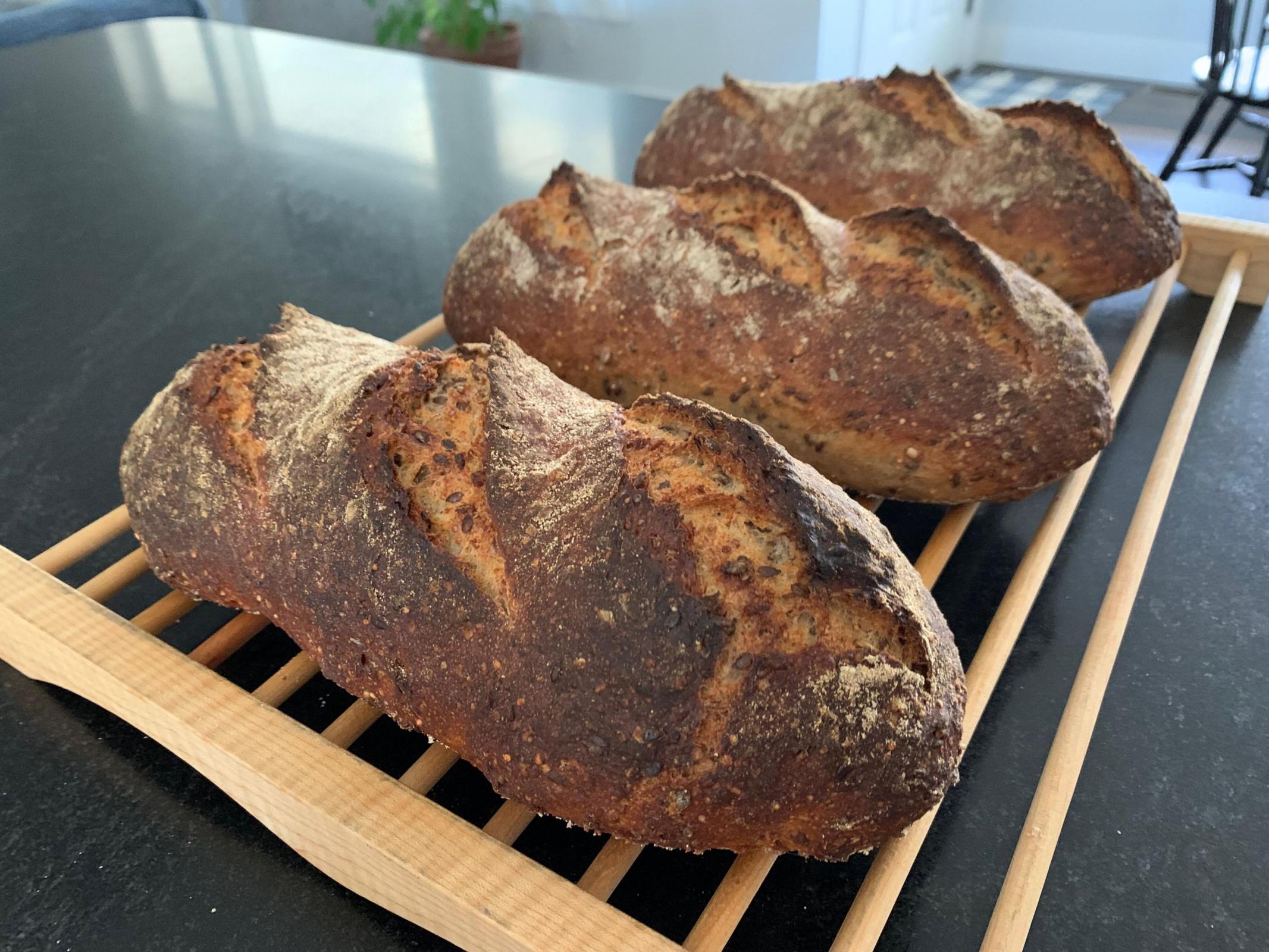
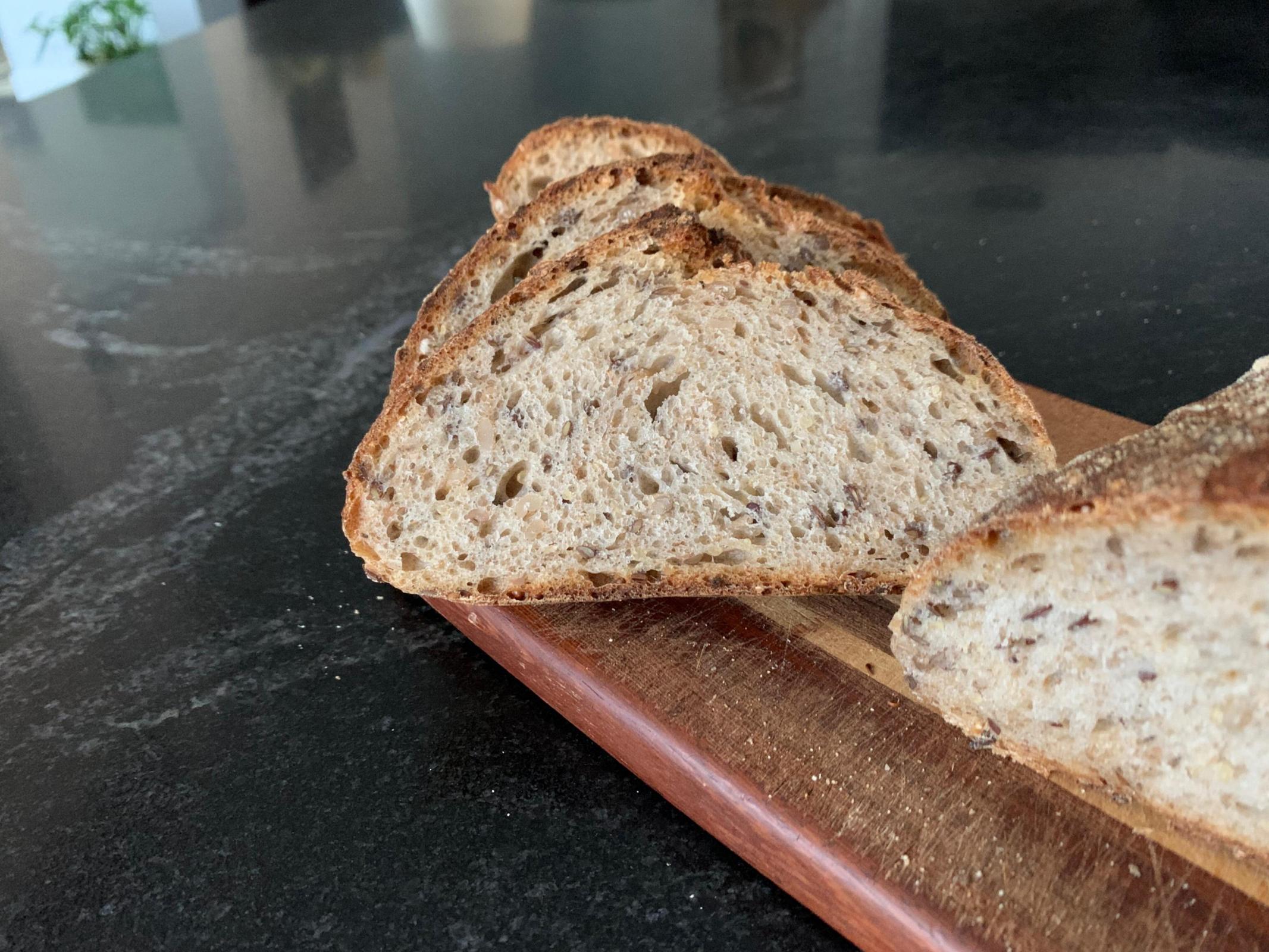
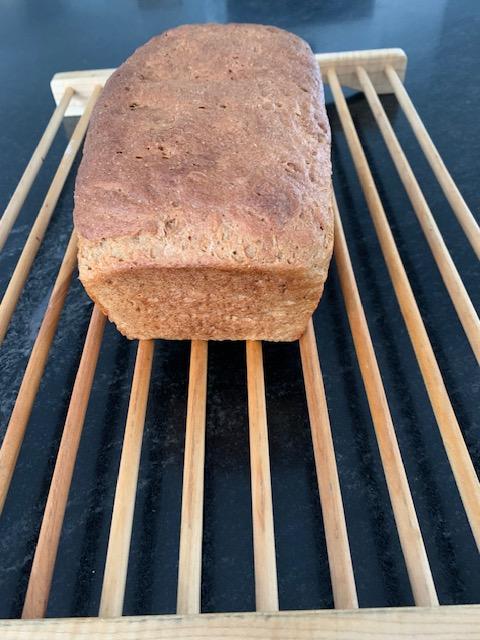
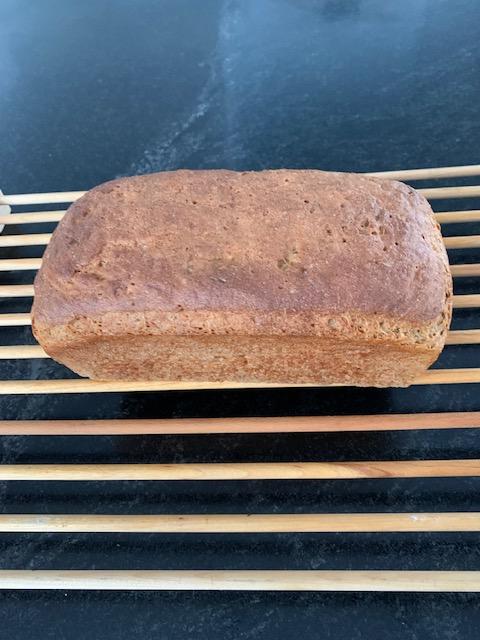
Submitted by PMcCool on July 27, 2008 - 2:42pm. Walnut Stout BreadThis weekend's bake, per my wife's request, was a walnut stout bread. The recipe that I used (note that all measurements are volumes, not weights) can be found here: http://www.kitchenlink.com/mf/2/4133. We first saw it printed in the Kansas City Star some years ago; the link attributes it to the Houston Chronicle. It's probably one of those recipes that was reprinted widely, since it is so good. Oh, and don't miss the Cheddar-Ale spread recipe at the bottom of the page. It is wonderful with this bread! There are a couple of insights that I can offer, having made this bread on several occasions. It is essentially a rye bread, which means that the crumb is very smooth and somewhat dense. The dough will be sticky as you handle it. The recipe suggests adding flour during kneading to control the stickiness but I elected to knead with one hand and clean the countertop (and my hand) with a plastic dough scraper. It helps to keep the finished bread from being too dry. The recipe merely says "rye flour". I don't know if it means white rye, medium rye, or whole rye. In my case, whole rye flour was on hand, so that is what I used and it turned out fine. The recipe also requires 1 Tablespoon of coriander, and that is not a misprint. Between the coriander and the anise seed, it is a very fragrant bread. As for the stout, I've used Guinness on previous occasions with good results. This time, I used Boulevard Brewery's Dry Stout (local to Kansas City) with equally delicious results. I think you could get away with using any dark beer or ale, whether stout, porter, bock or dunkel. The flavor may shift a bit, but it wouldn't upset the overall results. Obviously, the richer the flavor of the beer or ale, the richer the flavor of the bread. The walnuts are, to my tastes, essential for the bread. They contribute both flavor and a crunch that play off the other flavors and textures very nicely. The recommended baking time is 35-45 minutes at 375F. I checked a loaf's temperature at the 40-minute mark and it was only about 180F, so I left it in for another 10 minutes. If it had been taken out at the recommended time, it would have been gummy. Since I only make this every two or three years, I haven't really experimented with different temperature/time combinations. Here is a picture of the finished loaves:
Paul Submitted by PMcCool on June 15, 2008 - 2:47pm. Updated Kitchen - PhotosWhat follows is a case study of "Its beautiful! Let's change it!" When we moved into our present house in August 2007, one of the things that we especially liked about it was the large, open kitchen with lots of cabinet space and room to maneuver. No more tripping over each other, as in the cramped kitchen of the previous house; no more trying to find a place to set something down that wasn't already occupied by something else. It was pretty typical of houses that were built in this area in the mid-1990's; lots of honey-oak cabinetry, formica counter tops, ceramic tile backsplashes, etc. We have, over the years, been collecting ideas of things we would like to have in our kitchen. There was the "If money was no object" list and there was the "Get real!" list. One of the things that we fell in love with a few years ago was soapstone for counter tops. I don't recall where or how we first became aware of it, but I do remember that after seeing it used (and still usable) in a Shaker village built in the mid-1800s we figured that durability wasn't going to be a problem. I'll spare you the rationalization / sales pitch as to why we chose it over other options. Let's just say we like it. In looking at the somewhat worn Formica counter tops that were in the house, we decided that this might just be the time and place to take the plunge. Once the decision about counter tops was made, several other things followed in rapid progression. For instance, to take out the existing countertops, the existing backsplash had to be removed. Besides, white ceramic tile wouldn't have complement the new soapstone counters. To get all of the backsplash out, the existing microwave oven had to be pulled. Said microwave not only functioned poorly, it's vent fan recirculated cooking odors back into the house instead of venting outdoors. Oh, and the dinged up, surface-mounted porcelain sink? That had to go. While they're messing with the plumbing anyway, let's get a new disposal, too. To quote the King of Siam: "Et cetera, et cetera, et cetera." So, by choosing new counter tops, we got: - new counter tops (natch) - new backsplash - new microwave, vented outdoors - new undermount sink - new faucet - new disposal - new switches and outlets (to coordinate with new backsplash) - new pulls for the drawers and cabinets - new under-cabinet lights Talk about unforeseen consequences! The steam-injection oven remains on the "If money were no object" list. We decided that we could live with the existing white refrigerator, even though all of the other appliances are black. Here is how things looked at the outset:
Another "before" view:
The first thing to go was the backsplash and counter tops. Not having a place to set things down for a couple of weeks was an adjustment we never quite got used to:
The day after the wrecking crew tore out the backsplash and counters, another individual came to take the final measurements and make the templates that the stone fabricator would need to cut the raw slabs into the finished pieces for the counter tops. A crew came back to install the wiring for the puck lights underneath the upper cabinets while the stone fabricator was doing his thing. Under-cabinet lighting wasn't something that had been on either list but after seeing how much darker the slate tiles were going to be, compared to the previous white ceramic tiles, we decided that it would be a good thing to have. And then came the day that the new counters arrived:
The installer in the above picture is finishing a seam between two sections of counter top. Note that he has already installed the under-mount sink. The final step for installing the counter tops was the application of a coat of mineral oil. When soapstone is oiled, it darkens dramatically. Since the stone isn't porous, I'm not sure exactly why it works. The closest approximation I can think of is the difference between dry pavement and wet pavement, particularly when driving at night, in the sense that the oil fills in microscopic irregularities on the stone's surface in much the same way that rain fills in the irregularities of the pavement's surface, making it look much darker. Or maybe I'm the one that's all wet. Anyway, oiling is not required. It does nothing for the stone, other than change its appearance. My wife thinks that she will probably not oil our counters with any frequency, if at all. She prefers the "dry" look. Here's a picture that shows part of the stone oiled and part of it dry:
Over the next couple of days, the slate tile backsplash was installed, grouted and sealed. You can also see two of the puck lights under the upper cabinets, along with the new faucet at the sink and the new pulls on the cabinets and drawers in this shot:
And a couple of more shots showing the finished work:
Additional photos, if you are interested, are located at http://s94.photobucket.com/albums/l111/pemccool/Kitchen/. The before and after order is scrambled; Photobucket seems to adhere to the LIFO approach for inventorying multiple uploads. If any of you know how to reshuffle the order of the photos in a Photobucket album, please tell me how. We had dithered about whether or not we should refinish the cabinets, eventually defaulting to a wait and see approach. Now that everything is in, we are content to keep them as they are. We are very satisfied with how things have turned out, even though some of the et ceteras drove the price up higher than my informal initial estimate. We expect to be using, and liking, this kitchen for a long, long time. Bottom line? "It's beautiful! Don't change a thing!" Submitted by PMcCool on June 13, 2008 - 6:22pm. Levy's Real Jewish RyeI had occasion to try several new things last weekend: Rose Levy Berenbaum's recipe for "Levy's" Real Jewish Rye Bread, one of my recently acquired bannetons from SFBI, and the Pampered Chef equivalent of a La Cloche (which has been sitting around unused for years). This also marked the second time that I have made bread on the new soapstone countertops that were recently installed. The recipe comes from RLB's "The Bread Bible". The bread contains 3.3 oz of rye flour, vs. 8.5 oz of bread flour, so it is scarcely any more sticky than a wheat dough would be. And with 2 tablespoons of caraway seeds, rye isn't the dominant flavor. The bread begins with a yeasted sponge, which is allowed to ferment 1-4 hours. It eventually bubbles through a flour layer that is placed on top of the sponge:
Once the sponge has fermented, the flour mixture, oil and salt are stirred in. The dough is then kneaded and left to ferment under an overturned bowl for a 20-minute rest:
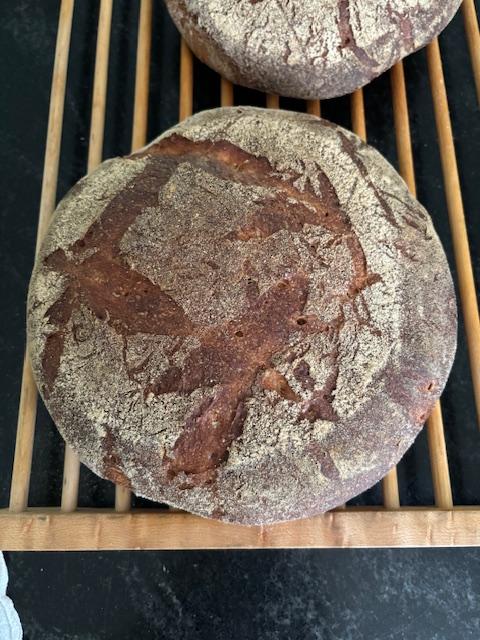
After the dough has rested, it is kneaded again and then allowed to rise until it is doubled. At that point, it is given a letter fold, then returned to the bowl until it doubles again. After the second rise, the dough is flattened slightly and then shaped into a ball and allowed to rise until it has doubled. Ms. Levy recommends that the final rise after shaping occur in a covered bowl. I opted to use a fabric-lined banneton, dusted with rice flour, covering the exposed surface with plastic wrap to keep it from drying. Ms. Levy suggests baking either on a baking sheet with steam, or in a cloche. In both cases, she recommends having a baking stone in the oven as it preheats, then setting either the baking sheet or the (also preheated) cloche on the baking stone. It seemed like overkill, but I followed the instructions as given, using the cloche. The risen loaf was tipped out onto parchment paper, slashed, then placed in the cloche and covered. I'll need to practice the technique a bit. I was a bit gun-shy about burning myself on either the cloche base or its lid, so I wasn't as gentle with placing the loaf as I should have been. It deflated slightly but recovered most of the loss with oven spring. Based on the directions, I pulled the cover from the cloche about 10 minutes before the estimated completion of the baking time, expecting that it would finish browning during those last few minutes. Instead, I saw that the loaf was already well-browned. So, I stuck a thermometer in it, which quickly registered 210F. At that point I declared it done and placed it on the rack to cool. Here's how it looked:
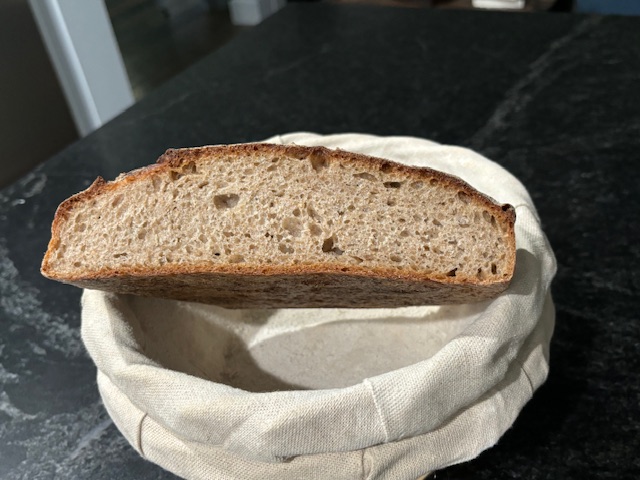
And a shot of the crumb, taken the next morning:
More of the color comes from the malt syrup in the recipe than from the whole rye flour that I used. The crumb is firm and moist, the crust thin and chewy. It makes a mean ham and Swiss sandwich. While I like caraway in a rye bread, the amount in this bread is more than I would use for my tastes. Next time I make it, I will either cut back on the caraway, or substitute fennel or dill, which will be more to my liking. Thank you, RLB. This is good stuff! Paul Submitted by PMcCool on December 10, 2007 - 10:03am. Viva Tortillas!Well, if I had had my druthers, I would have been in San Diego for the meet. After all, I was in Ensenada, which is pretty close. Compared to Kansas City, that is. But, no, I couldn’t get away from work for a fun Saturday with other TFL-ers. Submitted by PMcCool on October 30, 2007 - 7:06pm. A baking vacationSince Labor Day weekend, I have been out of the country on business trips almost constantly. Most of my time is spent in the Ensenada area, which is about a 90-minute drive south of San Diego. There was a 1-week trip to Trinidad (also business) but, other than the odd weekend back home every other week, I’ve been here in Ensenada the whole time. The only exception was last week, when I spent a week of vacation at home. Submitted by PMcCool on July 2, 2007 - 7:53pm. Wheat Harvest in KansasIn spite of the crazy, rainy weather of the past week or two, farmers in Kansas and other Great Plains states are trying to get the wheat harvested whenever field conditions allow. On my way home from work this evening, I saw these guys making their way across a field:
Submitted by PMcCool on May 30, 2007 - 9:36am. Vacation's overAfter being on vacation 10 days, it’s taken me almost 2 days of intermittent poking around to catch up on the various goings on at TFL. This is one busy bunch of bakers! I especially enjoyed the JMonkey/TattooedTonka sourdough starter event and the reminiscing by others about how they got started with making bread. Submitted by PMcCool on May 11, 2007 - 5:13am. Da UPMini Oven and Eric, Maybe the world is smaller than I think! There are some professors at Tech whom I remember very clearly. One is David Cimino, who taught a couple of my Physics courses. He really could draw a perfect circle, about 2 feet in diameter, on the blackboard. Pretty amazing to watch. The name Hanner sounds vaguely familiar but I don't think I had any classes with an instructor by that name. I never did meet a Bornhorst, although I watched Bruce Horst in the nets for the hockey Huskies. Probably doesn't count, eh? Submitted by PMcCool on April 16, 2007 - 7:12pm. Clayton's Buttermilk Whole Wheat BreadSince the breads I made most recently were both sourdough ryes, I was looking for something different this time around that would work well for sandwiches. My first inclination was to haul out an old favorite, a honey whole wheat bread. While flipping through Bernard Clayton's New Complete Book of Breads, I happened across a buttermilk whole wheat recipe that I had not tried previously. Since I had all of the necessary materials on hand, I thought that I would give it a try. The recipe follows [with my notes]. I'll also include additional comments at the end Submitted by PMcCool on April 2, 2007 - 11:05am. Not-quite-mega-bake weekendI dug my starter out of the refrigerator on Thursday and started refreshing it without a clear notion of what I would use it for, although some type of rye bread sounded good. Even though it had been 2-3 weeks since it was last used, it bounced back quickly and I had enough by Friday evening to start two different batches of bread. After browsing through recipes, I decided on the NY Deli Rye from Reinhart's BBA and a sourdough Dark Rye from the new KA Whole Grain cookbook. |